fill#
- regridding.fill(a, where=None, axis=None, method='gauss_seidel', **kwargs)[source]#
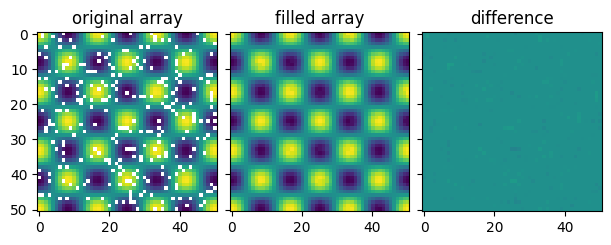
Fill an array with missing values by interpolating from the valid points.
- Parameters:
a (ndarray) – The array with missing values to be filled
where (None | ndarray) – Boolean array of missing values. If
None(the default), all NaN values will be filled.axis (None | int | Sequence[int]) – The axes to use for interpolation. If
None(the default), interpolate along all the axes of a.method (Literal['gauss_seidel']) – The interpolation method to use. The only option is “gauss_seidel”, which uses the Gauss-Seidel relaxation technique to interpolate the valid data points.
kwargs – Additional method-specific keyword arguments. For the Gauss-Seidel method, the valid keyword arguments are: -
num_iterations=100, the number of red-black Gauss-Seidel iterations to perform.
- Return type:
Examples
Set random elements of an array to NaN, and then fill in the missing elements using the Gauss-Seidel relaxation method.
import numpy as np
import matplotlib.pyplot as plt
import regridding

# Define the independent variables
x = 3 * np.pi * np.linspace(-1, 1, num=51)
y = 3 * np.pi * np.linspace(-1, 1, num=51)
x, y = np.meshgrid(x, y, indexing="ij")

# Define the array to remove elements from
a = np.cos(x) * np.cos(y)

# Define the elements of the array to remove
where = np.random.uniform(0, 1, size=a.shape) > 0.9

# Set random elements of the array to NaN
a_missing = a.copy()
a_missing[where] = np.nan

# Fill the missing elements using Gauss-Seidel relaxation
b = regridding.fill(a_missing, method="gauss_seidel", num_iterations=11)

# Plot the results
fig, axs = plt.subplots(
    ncols=3,
    figsize=(6, 3),
    sharey=True,
    constrained_layout=True,
)
kwargs_imshow = dict(
    vmin=a.min(),
    vmax=a.max(),
)
axs[0].imshow(a_missing, **kwargs_imshow);
axs[1].imshow(b, **kwargs_imshow);
axs[2].imshow(a - b, **kwargs_imshow);
axs[0].set_title("original array");
axs[1].set_title("filled array");
axs[2].set_title("difference");